
Novel machine learning model combining consensus nested cross-validation and minimum redundancy maximum relevance for identifying current suicidal symptoms in young people with major affective disorders
M.-H. Chen1,2, H.-J. Wu1,2, Y.-M. Bai1,2, J.-W. Hsu1,2, W.-C. Lin1,2
1Taipei Veterans General Hospital, Psychiatry, Taipei, Taiwan, 2National Yang Ming Chiao Tung University, Psychiatry, Taipei, Taiwan
Background: Previous neuroimaging-based machine learning studies involving adolescents have achieved accuracies below 80% in identifying suicide risk, highlighting the limitations of traditional feature selection methods when applied to the developing brains of young individuals.
Aims & Objectives: The study aimed to develop a neuroimaging-based machine learning predictive model for youth suicide.
Method: This study included 184 youths who were aged approximately 18 years and had major affective disorders. Among them, 94 had current suicidal symptoms (CS) and 90 did not (NS)). All participants underwent resting-state functional magnetic resonance imaging. Neuroimaging data were divided into training (CS = 84, NS = 80) and independent testing (CS = 10, NS = 10) sets. The novel consensus nested cross-validation (cnCV)–minimum redundancy maximum relevance (mRMR) feature selection method was combined with a linear support vector machine classifier.
Results: The cnCV–mRMR strategy produced a robust machine learning model that distinguished CS in youths with major affective disorders, achieving an accuracy of 85% in the testing set and 84% in the validation set. The top predictors for identifying CS included the putamen, nucleus accumbens, anterior cingulate cortex, posterior cingulate cortex, superior temporal sulcus, and inferior parietal cortex, corresponding to the reward, salience, default mode, social processing, and dorsal attention networks, respectively.
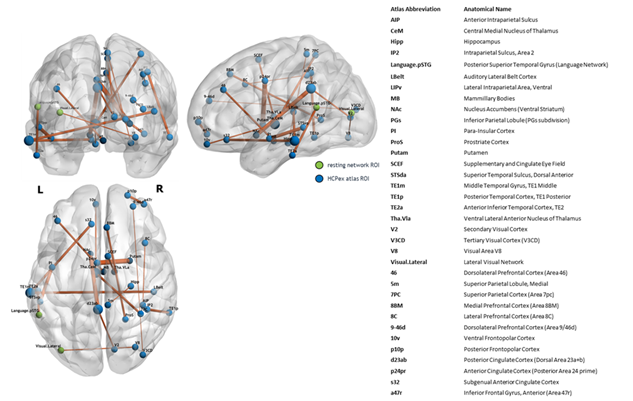
Discussion & Conclusions: Youth suicide was associated with dysfunction across multiple networks instead of impairment in a single network. By integrating the cnCV–mRMR feature selection method, we developed a machine learning framework that consistently and accurately differentiated youths with CS from those without.
In sessions