
Ambient temperature variation and psychiatric emergencies: associations with symptom profiles in a one-year retrospective study
C.-I Liu1, W.-H. Chen2, Y.-A. Liao1, C. Chen3
1National Taiwan University Hospital, Psychiatry, Taipei, Taiwan, 2Yongkang Psychiatry Clinic, Psychiatry, Taipei, Taiwan, 3Taipei City Psychiatric Center, Taipei City Hospital, Department of Addiction Sciences, Taipei, Taiwan
Background: Ambient temperature has been reported to correlate with suicide rates and psychiatric manifestations in many countries. However, the precise effects and associations with specific psychiatric conditions remain unclear.
Aims & Objectives: This retrospective study aimed to investigate the relationship between emergency psychiatric visits and both ambient temperature and temperature variation.
Method: We analyzed all emergency psychiatric visits (n = 803) at a tertiary hospital from June 30, 2014, to June 29, 2015. Chief complaints were categorized into anxiety/depression, behavioral and psychological symptoms of dementia (BPSD), disturbance of conduct, delirium, insomnia, manic presentation, psychotic presentation, somatic complaints, and substance-related issues. Daily counts for each category were obtained. Spearman correlations, controlling for relative humidity and wind speed, were conducted between visit counts and meteorological factors, including daily mean temperature, intradaily temperature difference, interdaily temperature difference, and maximal temperature difference over the preceding five days.
Results: Higher daily mean temperature was positively correlated with visits for anxiety/depression (r = 0.112). Lower interdaily temperature difference was associated with more insomnia-related visits (r = –0.147). Greater short-term temperature variation was linked to increased manic presentations (r = 0.163), whereas fewer somatic complaints were observed under the same conditions (r = –0.152). Figure 1 presents these findings, with text indicating the corresponding p-values.
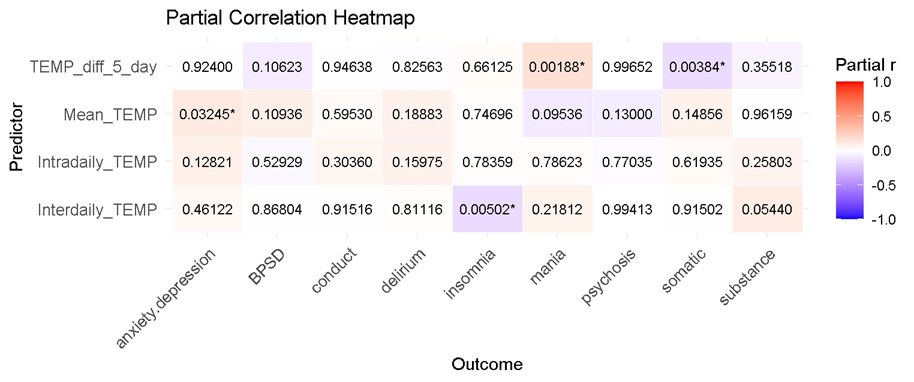
Discussion & Conclusions: Our findings support previous evidence linking higher ambient temperature with increased anxiety/depression, potentially contributing to elevated suicide risk. Importantly, we highlight a more nuanced relationship between temperature fluctuations and psychiatric emergencies: greater temperature variation may trigger mood instability, reflected in manic presentations, but simultaneously reduce somatic and sleep-related complaints. These results suggest that temperature dynamics, beyond absolute ambient temperature, play a significant role in psychiatric symptomatology. Further research is warranted to explore the mechanisms underlying these associations and their implications for mental health services and suicide prevention strategies.
In sessions