
Relapse rate, clinical efficacy, and safety of the 3-month paliperidone palmitate in community-dwelling patients with schizophrenia
F. Qian1, J. Tang1, Y. Su1, S. Wang2
1Southern University of Science and Technology, School of Public Health and Emergency Management, Shenzhen, China, 2Guangdong Provincial People’s Hospital, Guangdong Mental Health Center, Guangzhou, China
Background: Little is known about the effects of paliperidone palmitate 3-month (PP3M) on relapse prevention, efficacy, and functional outcomes, particularly among community-dwelling patients in China.
Aims & Objectives: We aimed to assess the relapse rate, clinical efficacy, and safety of PP3M in real-world community populations.
Method: We conducted a 48-week, prospective, single-arm, multicenter study at community mental health centers across Guangdong Province, China. Patients with a clinical diagnosis of schizophrenia who initiated PP3M treatment were consecutively enrolled. A total of 230 patients initiated PP3M were enrolled in the study. The primary outcome was the prevention relapse at 48 weeks, estimated using the Kaplan-Meier method. Secondary outcomes included changes in symptom severity, social functioning, treatment satisfaction, quality of life, medication adherence, family burden, and adverse events. These longitudinal changes from baseline to 48 weeks were analyzed using generalized linear mixed effects models (GLMM).
Results: Of the 230 participants enrolled, 10 experienced relapse, 8 were lost to follow-up, and 222 (96.5%) completed the 48-week study. The estimated overall relapse rate at week 48 was 4.4% (95% CI: 1.7% to 7.0%), with 2.6% (0% to 5.5%) in the mild group, 6.9% (1.4% to 12.1%) in the moderate group, and 4% (0% to 11.4%) in the severe group. The differences among the three groups were not statistically significant (P = 0.320). From baseline to the week 48,the Positive and Negative Syndrome Scale (PANSS) total score, positive symptom, negative symptom, and general psychopathology symptom scores, decreased by -6.16 (-7.58 to -4.74; P < 0.001), -0.93 (-1.36 to -0.49; P < 0.001), -1.86 (-2.47 to -1.24; P < 0.001), and -3.06 (-3.78 to -2.33; P < 0.001), respectively. Additionally, consistent and statistically significant improvements were also observed in social functioning, treatment satisfaction, quality of life, and the incidence of adverse events (all P < 0.001). Furthermore, the subgroup analysis identified significant inter-group differences (P < 0.001), with patients in the severe symptoms group exhibiting greater improvement over time.
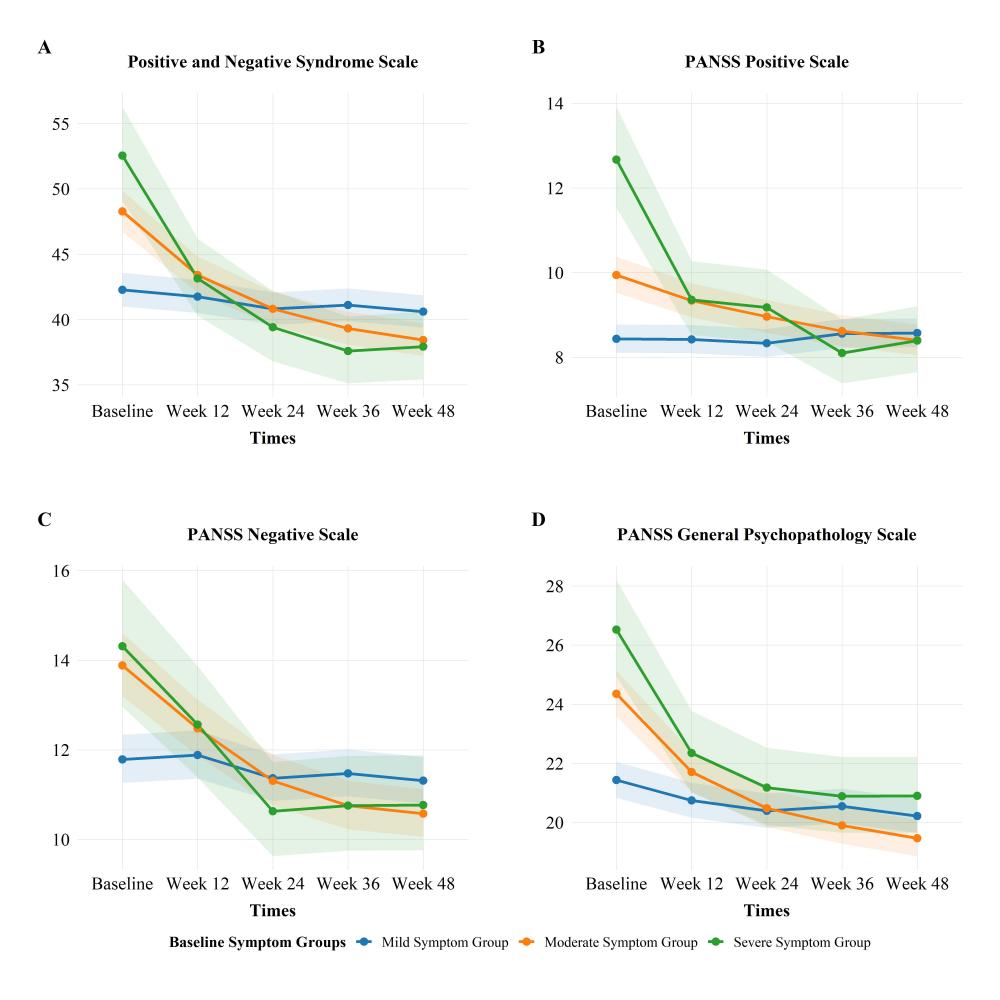
Discussion & Conclusions: This study suggests that PP3M is effective in reducing relapse rates, alleviating symptoms, and improving both quality of life and social functioning among individuals with schizophrenia living in the community.
In sessions