
Korean medication algorithm project for depressive disorder 2025 (III): child and adolescent
S. Shim1, S.-W. Hahn2
1Soonchunhyang University Cheonan Hospital, Psychiatry, Cheonan, Korea, Republic of, 2Soonchunhyang University Seoul Hospital, Psychiatry, Seoul, Korea, Republic of
Background: In Korea, the Korean Medication Algorithm for Major Depressive Disorder, based on expert consensus on depression medication, was first published in 2002. Afterwards, based on new research results and accumulated clinical experience, the first revised edition, the Korean Medication Algorithm for Depressive Disorders 2006, was published in 2006. In 2012, the second revision, KMAP-DD 2012, was published. In particular, drug treatment for major depressive disorder in children and adolescents was first investigated in KMAP-DD 2012, and in KMAP-DD 2017, treatment strategies for disruptive mood dysregulation disorder, a new category in DSM-5, were added. In KMAP-DD 2021, treatment strategies for children and adolescents were distinguished, and differentiated approaches for DMDD treatment according to gender were presented. Subsequently, in the revised KMAP-DD 2025, more sophisticated and specific treatment strategies for major depressive disorder and DMDD in children and adolescents were established by reflecting the latest research results accumulated over the past four years and the actual experiences of domestic clinical experts.
Aims & Objectives: The Korean Medication Algorithm Project for Depressive Disorder 2025 (KMAP-DD 2025) represents a revision of the prior iterations.
The primary objective of the present study was to refine treatment guidelines for major depressive disorders (MDDs) in child and adolescent populations.
The primary objective of the present study was to refine treatment guidelines for major depressive disorders (MDDs) in child and adolescent populations.
Method: The survey instrument comprised 21 questionnaires specifically tailored for children and adolescents.
A total of 42 out of 70 experts in child and adolescent psychiatry completed and returned the survey questionnaires.
A total of 42 out of 70 experts in child and adolescent psychiatry completed and returned the survey questionnaires.
Results: 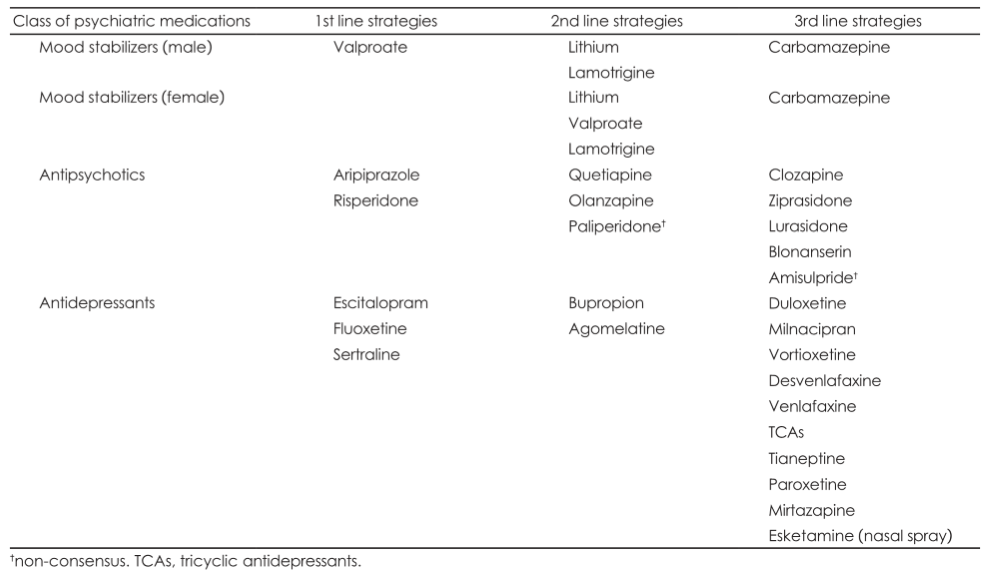
Antidepressant (AD) monotherapy was identified as the first-line treatment option for major depressive disorder (MDD) of mild-to-moderate severity. For severe MDD without psychotic features in children and adolescents, both AD monotherapy and AD augmentation with atypical antipsychotics (AAPs) were recommended as first-line treatments.In cases of MDD with psychotic features, AD augmentation with AAPs was the preferred first-line treatment strategy.
Antidepressant (AD) monotherapy was identified as the first-line treatment option for major depressive disorder (MDD) of mild-to-moderate severity. For severe MDD without psychotic features in children and adolescents, both AD monotherapy and AD augmentation with atypical antipsychotics (AAPs) were recommended as first-line treatments.In cases of MDD with psychotic features, AD augmentation with AAPs was the preferred first-line treatment strategy.
Discussion & Conclusions: We have developed a treatment algorithm specifically for child and adolescent populations with depressive disorders, offering enhanced specificity compared to the KMAP-DD 2021.
It is anticipated that this algorithm will furnish clinicians with valuable information and facilitate the management of depressive disorders in children and adolescents.
It is anticipated that this algorithm will furnish clinicians with valuable information and facilitate the management of depressive disorders in children and adolescents.
In sessions