
Effects of a nature-based intervention on cognitive function in older adults with mild cognitive impairment
D.H. Kim1, E.K. Kwan2, Y.S. Moon3
1Chuncheon Sacred Heart Hosp. , College of Medicine, Hallym University, Psychiatry, Chuncheon, Korea, Republic of, 2College of Forest and Environmental Sciences, Kangwon National University, Division of Forest Science, Chuncheon, Korea, Republic of, 3Mind-Neuromodulation Laboratory, College of Medicine, Hallym University, Psychiatry, Chuncheon, Korea, Republic of
Background: Mild Cognitive Impairment (MCI) represents a high-risk stage for dementia. Pharmacological treatments for MCI have demonstrated limited efficacy and are frequently associated with adverse effects. Despite recent approvals of Donanemab and Lecanemab, their high cost, complex use, and serious side effects limit real-world applicability, highlighting the need for non-pharmacological approaches. Yet few non-pharmacological interventions are accessible in everyday settings. Nature-based interventions have shown potential cognitive benefits, but empirical validation for MCI populations remains limited.
Aims & Objectives: The present study aims to empirically investigate the effects of a nature-based intervention on cognitive function in older adults with MCI using a control group design matched for age and sex.
Method: Fifty older adults with clinically diagnosed MCI were recruited from a psychiatric outpatient clinic and local dementia centers. Using a control group design matched for age and sex, twenty-five participants were assigned to the intervention group and received a four-session nature-based intervention over four weeks, while matched controls received no intervention. Pre- and post-tests assessed cognitive, emotional, physiological, and physical functions. Forty-four participants completed the study.
Results: 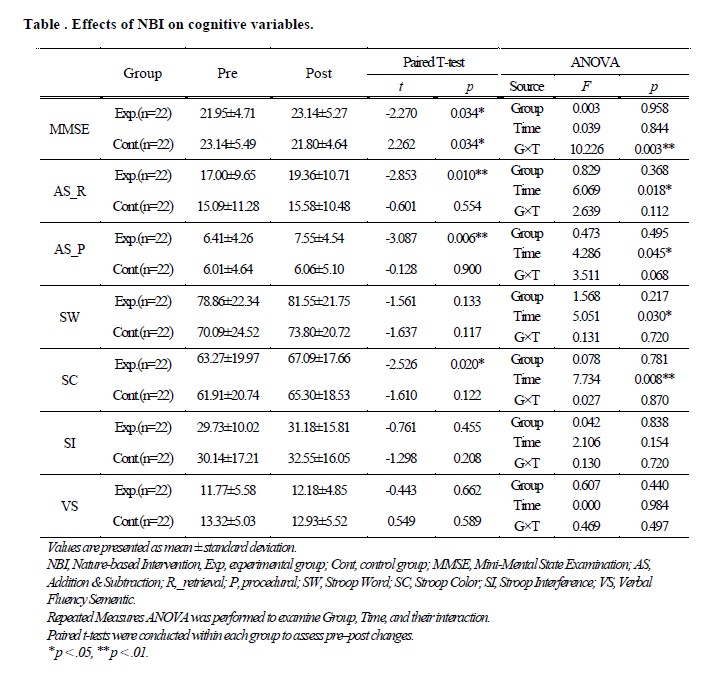 A significant interaction effect between time and group was found for MMSE scores (F = 10.226, p = .003), with the intervention group showing statistically and clinically meaningful improvement. Emotional, physiological, and physical indicators did not yield significant between-group differences.
Discussion & Conclusions: A short-term, nature-based intervention yielded cognitive benefits in older adults with MCI, supporting its feasibility as an accessible, non-pharmacological intervention. Further longitudinal randomized controlled trials are needed to confirm sustained effects across multiple domains.
In sessions