
Carbohydrate-Deficient Transferrin (%CDT) as a forensic biomarker for heavy alcohol use in driving license regranting programs: evidence from a Taiwanese population
M.-H. Hsieh1, H.-H. Huang1, S.-C. Huang1, R.-P. Lee2, C.-M. Lin1, Y.-H. Su3
1Tungs' Taichung MetroHarbor Hospital, Department of Psychiatry, Taichung City, Taiwan, 2Tungs' Taichung MetroHarbor Hospital, Research Assistant in Psychiatry, Taichung City, Taiwan, 3Tungs' Taichung MetroHarbor Hospital, Department of Nursing, Taichung City, Taiwan
Background: Carbohydrate-deficient transferrin (%CDT) is a highly specific biomarker for chronic heavy alcohol consumption and has been incorporated into legal and medical regulations for relicensing drunk-driving offenders in several European countries, typically using cut-off values between 1.7% and 2.1%. However, in Taiwan, there is currently no validated %CDT threshold for forensic application in alcohol-use monitoring or driving license regranting programs.
Aims & Objectives: To determine the optimal %CDT cut-off value that differentiates heavy drinkers from non-drinkers and to assess its sensitivity, specificity, and diagnostic accuracy (AUC) for forensic use in license regranting programs in Taiwan.
Method: A total of 50 individuals were recruited from a mandatory alcohol treatment and evaluation program supervised by the Taichung Motor Vehicle Office between 2020 and 2025. Participants were classified into heavy drinkers and non-drinkers. Heavy drinking was defined as ≥50–60 g of ethanol per day for a minimum of 2 consecutive weeks, confirmed by AUDIT and clinical interview. Based on this definition, 25 participants were enrolled who scored a 4 ("Daily or almost daily") on the 3rd question of the AUDIT questionnaire: "How often do you have six or more drinks on one occasion?"The control group consisted of 25 non-drinkers with an AUDIT score of less than 8, or an AUDIT-C score of 0, indicating little to no alcohol consumption. ROC curve analysis was used to determine the area under the curve (AUC), optimal cut-off based on Youden’s index, and additional thresholds prioritizing specificity for forensic purposes.
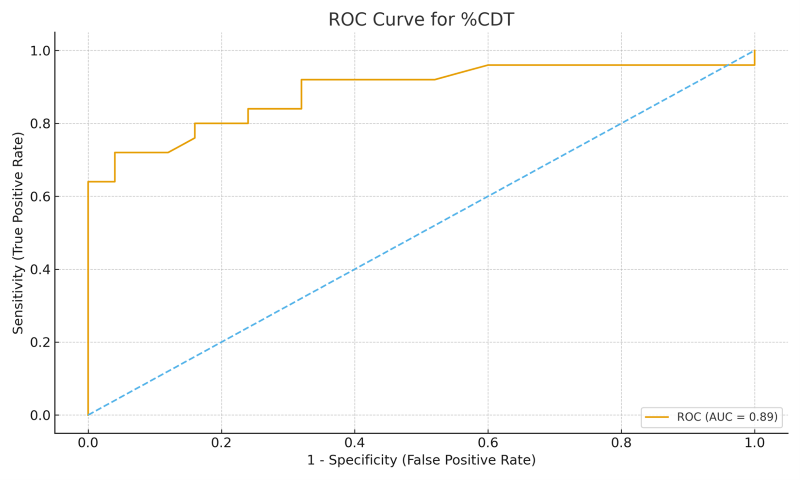
Results: The %CDT levels were significantly higher among heavy drinkers compared to non-drinkers(2.67% vs. 1.55%, p < 0.001). ROC curve analysis demonstrated an AUC of 0.89, indicating good diagnostic accuracy. The optimal cut-off value determined by Youden’s index was 1.9, yielding a sensitivity of 0.72 and specificity of 0.96. For forensic applications, a threshold of ≥2.03% achieved 100% specificity with sensitivity of 0.64.
Discussion & Conclusions:
%CDT demonstrated high diagnostic accuracy for identifying heavy alcohol use in Taiwanese drunk-driving offenders. A dual-threshold model is recommended: ≥1.90% for clinical screening and ≥2.03% for forensic decision-making.These findings provide the first locally validated reference for %CDT in Taiwan. Larger-scale studies are recommended to enhance generalizability.
| Cut-off (%CDT) | Sensitivity | Specificity | Application |
| 1.90% | 0.72 | 0.96 | Clinical (optimal balance; Youden index) |
| 2.03% | 0.64 | 1.00 | Forensic use (100% specificity, zero false-positives) |
%CDT demonstrated high diagnostic accuracy for identifying heavy alcohol use in Taiwanese drunk-driving offenders. A dual-threshold model is recommended: ≥1.90% for clinical screening and ≥2.03% for forensic decision-making.These findings provide the first locally validated reference for %CDT in Taiwan. Larger-scale studies are recommended to enhance generalizability.
In sessions