
Psychotropic use, initiation, and healthcare trajectories in the 180 days before suicide
Y.-S. Li1, S.-J. Tsai1,2, C.-M. Cheng1,2, Y.-M. Bai1,2, T.-J. Chen3,4, M.-H. Chen1,2
1Taipei Veterans General Hospital, Department of Psychiatry, Taipei, Taiwan, 2National Yang Ming Chiao Tung University, College of Medicine, Department of Psychiatry, Taipei, Taiwan, 3Taipei Veterans General Hospital, Department of Family Medicine, Taipei, Taiwan, 4National Yang Ming Chiao Tung University, Institute of Hospital and Health Care Administration, Taipei, Taiwan
Background: Suicide is a major public health challenge globally and the tenth leading cause of death in Taiwan. Although psychiatric disorders, emergency visits, and psychotropic prescribing are known correlates of suicide, evidence from Asian populations remains limited—particularly regarding the timing, continuity, and clinical context of psychiatric versus non-psychiatric care preceding death.
Aims & Objectives: We examined 180-day healthcare utilization and psychotropic prescribing patterns before suicide and compared care delivered in psychiatric versus non-psychiatric settings. We hypothesized that suicide risk would be associated with distinct temporal patterns involving fragmented care and new psychotropic initiation outside psychiatric services.
Method: Using Taiwan’s National Health Insurance Research Database, we conducted a matched case–control study including 238 suicide decedents and 2,380 controls matched on age, sex, income, and urbanization. Psychiatric visits, emergency department (ER) visits, and psychotropic prescriptions were assessed across 3 time windows (0-30, 31-90, 91-180 days before suicide). Independent associations were evaluated using multivariable logistic regression.
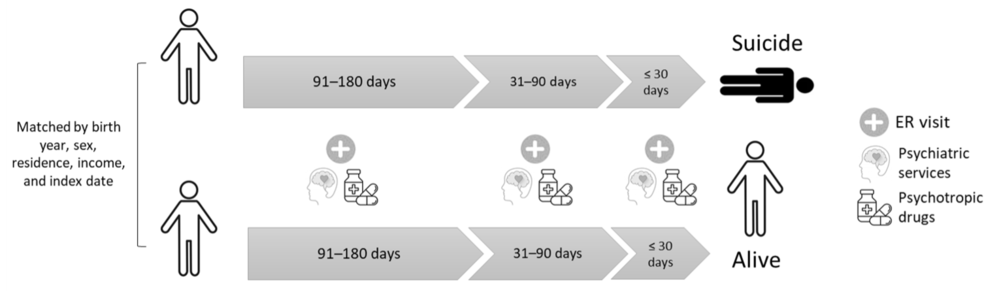
Results: Suicide decedents had higher rates of psychiatric diagnoses (38.2% vs. 14.8%), greater comorbidity, more psychiatric/ER visits and psychotropic use. Alcohol use disorder (OR 2.36), comorbidity (OR 1.33), psychiatric visits 91–180 days prior (OR 11.24), and frequent ER visits (OR 2.12-8.83) were independently associated with suicide. Notably, psychiatric visits within 90 days were not independently predictive, suggesting these encounters may reflect treatment engagement rather than escalating risk. Antidepressant prescriptions 31–90 days prior (OR 4.05) and benzodiazepine/Z-drug use across time windows (OR 1.80–2.55) were also associated with suicide. New initiation of mood stabilizers (OR 6.32) and benzodiazepines/Z-drugs (OR 3.35) within 30 days conferred especially high risk when prescribed in non-psychiatric settings.
Discussion & Conclusions: Both psychiatric and non-psychiatric encounters were clinically meaningful before suicide. While ER visits alone were insufficient to reduce risk, consistent psychiatric follow-up appeared protective. Strengthening suicide-risk detection in general medical settings, improving continuity of psychiatric care, and enhancing monitoring after new psychotropic initiation may improve prevention efforts.
In sessions