
Physical activity, weekend catch-up sleep, and depressive symptoms: mediating effects of high-sensitivity C-reactive protein
S.-Y. Kim1, D. Ho1, W.-J. Lim1
1Ewha Womans University College of Medicine, Psychiatry, Seoul, Korea, Republic of
Background: Emerging evidence suggests that inflammation may play a key role in depression, and lifestyle factors such as physical activity and weekend catch-up sleep may reduce inflammation—reflected by lower CRP levels—which could help alleviate depressive symptoms.
Aims & Objectives: We aimed to examine the effect of physical activity (PA) and weekend catch-up sleep (WCS) on depressive symptoms by evaluating their effects on high-sensitivity C-reactive protein (hsCRP) levels.
Method: Data were collected from 10,715 adults aged ≥ 19 years. PA and depressive symptoms were assessed using self-report scales. The WCS was calculated by subtracting self-reported average weekday sleep hours from weekend sleep hours, and serum hsCRP levels were measured using immunoturbidimetric methods. Given that depressive symptoms are characterized by their multifaceted nature, we identified specific symptoms associated with hsCRP levels. Path analysis was used to investigate the association between PA, WCS, hsCRP, and depressive symptoms, and that between PA, WCS, hsCRP, and specific symptoms related to hsCRP.
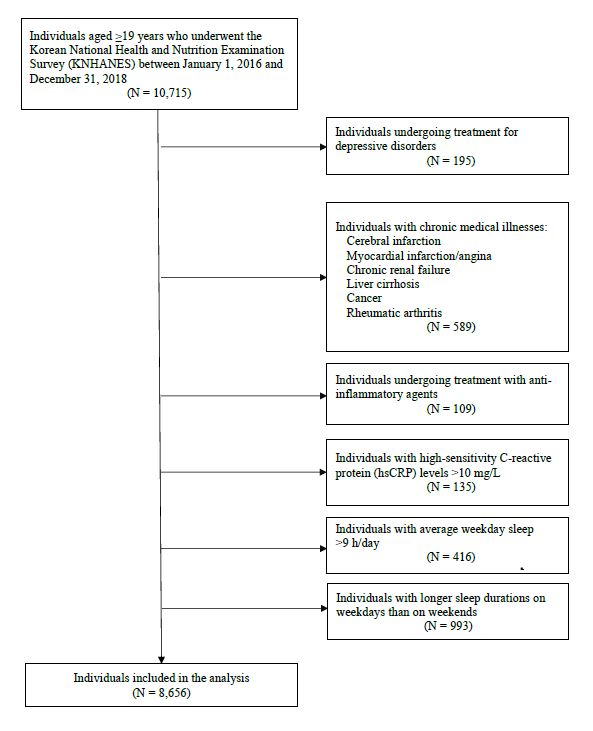
Results: Higher levels of PA and WCS were associated with a decreased risk of depressive symptoms through lowering hsCRP levels. Among various depressive symptoms, sleep problems and appetite changes were associated with hsCRP. In pathway analyses using them as dependent variables, higher levels of PA and WCS were also associated with a decreased risk of sleep problems and appetite changes through lowering hsCRP levels.
Table 1. Socio-demographic characteristics of the participants according to depressive symptoms.
hsCRP, high-sensitivity C-reactive protein; MET, metabolic equivalent of task.
Table 1. Socio-demographic characteristics of the participants according to depressive symptoms.
| PHQ ≥ 10 (n = 353) Mean ± SD or n (%) | PHQ <10 (n = 8,303) Mean ± SD or n (%) | p-value | ||
| Age | 51.51 ± 0.97 | 50.02 ± 0.18 | 0.135 | |
| Sex | Men | 109 (30.88) | 3,795 (45.71) | <0.001 |
| Women | 244 (69.12) | 4,508 (54.29) | ||
| BMI (kg/m2) | 23.91 ± 0.20 | 24.02 ± 0.04 | 0.632 | |
| Average weekday sleep duration (h/day) | 7.28 ± 0.10 | 7.66 ± 0.02 | <0.001 | |
| Average weekend sleep duration (h/day) | 6.48 ± 0.09 | 6.86 ± 0.01 | <0.001 | |
| Physical activity (MET-min/week) | 895.79 ± 59.34 | 1246.94 ± 16.76 | <0.001 | |
| Weekend catch-up sleep (h/day) | 0.80 ± 0.08 | 0.81 ± 0.01 | 0.943 | |
| hsCRP (mg/L) | 1.10 ± 0.08 | 0.99 ± 0.01 | 0.197 | |
Discussion & Conclusions: Increased levels of PA and WCS may help alleviate depressive symptoms, particularly sleep problems and appetite changes, by mitigating chronic inflammation. Therefore, ensuring adequate exercise time and compensating for inadequate weekday sleep during weekends are crucial for maintaining mental well-being.
In sessions