
Impact of having or living with a family member with dementia on suicidal ideation: mediating effect of sleep duration, quality of life, and depressive symptoms
D. Ho1, S.-Y. Kim1, W.-J. Lim1
1Ewha Womans University College of Medicine, Psychiatry, Seoul, Korea, Republic of
Background: Dementia is an irreversible progressive disease that imposes a substantial burden on patients and their families.
Aims & Objectives: This study examined the effects of having a family member with dementia on suicidal ideation, and explored mediating roles of sleep duration, quality of life (QoL), and depressive symptoms.
Method: Data were obtained from 231,674 adults using the 2024 Korean Community Health Survey. Key variables included self-reported dementia family status, depressive symptoms (Patient Health Questionnaire-9), QoL (EuroQol five-dimensional scale), and average sleep duration. Suicidal ideation during the previous year was assessed using a single item. A proxy variable for older spousal caregivers was defined as individuals aged ≥ 60 years, currently married, living with a spouse, having a family member with dementia, and living with that family member. Logistic regression and structural equation modeling (SEM) were used to examine associations and mediating pathways.
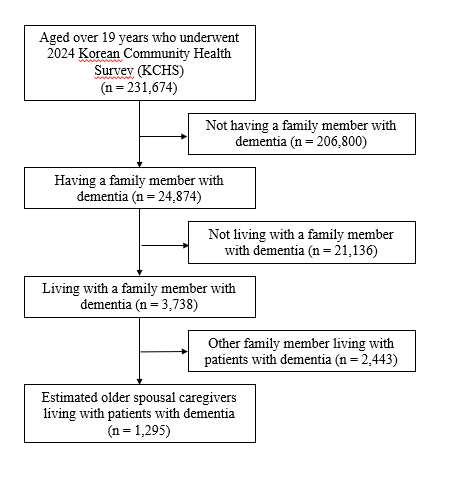
Results: Participants with a family member with dementia had higher odds of suicidal ideation than those without one (Odds ratio [OR] = 1.186, 95% confidence intervals [CI] = 1.122–1.253). Those living with a patient with dementia showed higher odds (OR = 1.244, 95% CI = 1.106–1.399). SEM revealed significant direct and indirect effects through depressive symptoms and QoL, with larger effects for the “living with dementia” model. In subgroup analyses, stronger path coefficients for suicidal ideation were observed among femen aged ≥ 65 years. Among older spousal caregivers, the path from depressive symptoms to suicidal ideation was significantly stronger than that of the other groups.
Table 1. Sociodemographic characteristics of participants according to whether they have a family member with dementia
Note. PHQ-9 = Patient Health Questionnaire-9. EQ-5D = EuroQol five-dimensional scale.
Table 1. Sociodemographic characteristics of participants according to whether they have a family member with dementia
| No dementia in family (n =206,800) | Dementia in family (n =24,874) | p-value | |
| Mean ± SD or n (%) | Mean ± SD or n (%) | ||
| Age | 56.53 ± 17.62 | 56.14 ± 16.46 | 0.001 |
| Gender Men | 94,589 (45.74) | 11,518 (46.31) | 0.090 |
| Femen | 112,211 (54.26) | 13,356 (53.69) | |
| Average sleep duration (hours) | 6.72 ± 1.30 | 6.70 ± 1.31 | < 0.001 |
| PHQ-9 | 2.40 ± 3.28 | 2.77 ± 3.62 | < 0.001 |
| EQ-5D | 0.93 ± 0.12 | 0.93 ± 0.14 | < 0.001 |
| Experience of suicidal ideation within one year Yes | 15,140 (7.32) | 2,333 (9.38) | < 0.001 |
| No | 191,624 (92.68) | 22,534 (90.62) |
Discussion & Conclusions: Managing QoL and depressive symptoms in family caregivers, particularly those living with patients with dementia, may prevent suicidal ideation.
In sessions