
Relationships between clinician adherence to guideline-recommended treatment and memory function in patients with schizophrenia
Y. Kawamata1, K. Ohi2, S. Ito3, Y. Yasuda3,4, M. Fujimoto3,5, H. Yamamori3,6, K. Fukumoto7, F. Kodaka3,8, J. Matsumoto3, N. Yasui-Furukori1, R. Hashimoto3
1Dokkyo Medical University School of Medicine, Department of Psychiatry, Mibu, Japan, 2Gifu University Graduate School of Medicine, Department of Psychiatry, Gifu, Japan, 3National Institute of Mental Health, National Center of Neurology and Psychiatry, Department of Pathology of Mental Diseases, Tokyo, Japan, 4Medical Corporation Foster, Life Grow Brilliant Mental Clinic, Osaka, Japan, 5Osaka University, Graduate School of Medicine, Department of Psychiatry, Osaka, Japan, 6Japan Community Health Care Organization Osaka Hospital, Department of Psychiatry, Osaka, Japan, 7School of Medicine, Iwate Medical University, Department of Neuropsychiatry, Iwate, Japan, 8The Jikei University School of Medicine, Department of Psychiatry, Tokyo, Japan
Background: Memory function impairment is severe in patients with schizophrenia, but improving memory function remains challenging. The use of benzodiazepines and anticholinergics, which are not recommended by pharmacological therapy guidelines for schizophrenia, has been associated with worsened cognitive function. However, it remains unclear whether better adherence by psychiatrists to pharmacological therapy guidelines for schizophrenia is associated with improved memory function.
Aims & Objectives: We aimed to investigate the relationship between psychiatrists’ adherence and memory function in patients with schizophrenia.
Method: To evaluate the associations between psychiatrists’ adherence to pharmacological therapy guidelines and memory function, we utilized the Individual Fitness Score (IFS), which includes multiple quality indicators, to assess each psychiatrist’s adherence to these guidelines in treating each patient. Memory function was measured using the Wechsler Memory Scale-Revised in a total of 351 patients, including 40 patients with treatment-resistant schizophrenia (TRS) and 311 patients with non-TRS.
Results: We found that psychiatrist adherence was significantly positively correlated with verbal memory (β = 0.145, p =6.45 ×10⁻³), attention/concentration (β =0.138, p =0.010), and delayed recall (β =0.167, p =1.57 ×10⁻³) in all patients with schizophrenia. Additionally, a nominal positive correlation was observed with visual memory (β =0.124, p =0.019). In non-TRS patients, the adherence of psychiatrists was significantly positively correlated with delayed recall (β =0.166, p =3.17 ×10⁻³) and nominally positively correlated with verbal memory (β =0.141, p =0.013) and attention/concentration (β =0.114, p =0.044) functions. In contrast, no significant associations were observed between the psychiatrists’ adherence and any memory functions in patients with TRS.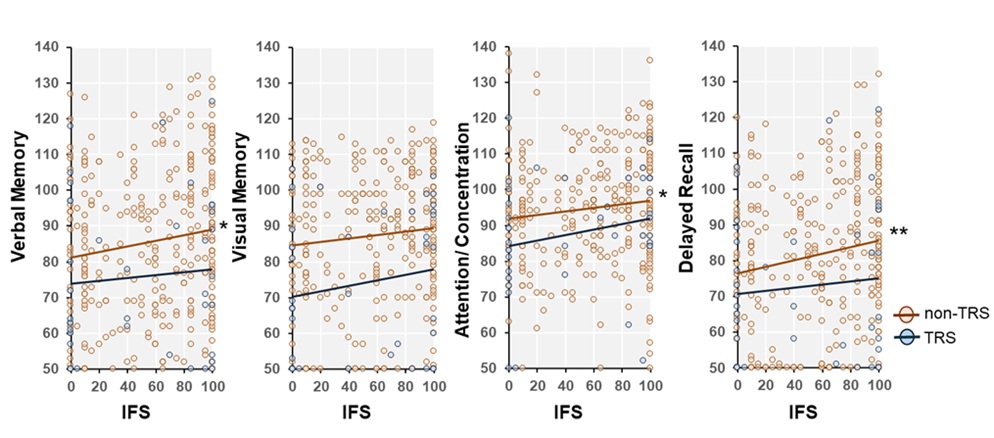
Discussion & Conclusions: These findings suggest that enhancing guideline education for psychiatrists might improve cognitive impairments in patients with schizophrenia.
In sessions