
Parsing neuroanatomical pathways linking stress to schizophrenia
N. Feng1, X. Ma2, W. Pu3, Q. Luo4
1Fudan University, National Clinical Research Center for Aging and Medicine at Huashan Hospital, Research Institute of Intelligent Complex Systems, Shanghai, China, 2The Second Xiangya Hospital of Central South University, Department of Psychiatry, National Clinical Research Center for Mental Disorders, and National Center for Mental Disorders, Changsha, China, 3The Third Xiangya Hospital of Central South University, Department of Clinical Psychology, National Clinical Research Center for Mental Disorders, Changsha, China, 4Fudan University, National Clinical Research Center for Aging and Medicine at Huashan Hospital, Research Institute of Intelligent Complex Systems, Institute of Science and Technology for Brain-Inspired Intelligence, Shanghai, China
Background: Stress is a key environmental risk factor for schizophrenia. However, the stress-schizophrenia mediating pathway remains undetermined mainly due to its heterogeneity.
Aims & Objectives: To account for the heterogeneity, a stratification algorithm was designed to elucidate the stress-psychosis mediating patterns of volumetric changes across multiple brain regions.
Method: This study analyzed the brain's grey-matter volume, polygenic schizophrenia risk, stressful life event, and psychotic-like experience in the IMAGEN cohort (N=975, age 19). A mediating-pathway stratification algorithm was used to identify subgroups in which individuals share the same pattern of volumetric changes that mediates the stress-schizophrenia relationship. We trained subgroup classifiers and applied them to validation datasets, including unaffected first-degree relatives of schizophrenia (UFR-SZ) and early-onset schizophrenia (EOS) patients.
Results: We identified four subgroups with distinct mediating patterns of grey-matter volumetric changes. One subgroup had a tri-network pattern of increased grey-matter volumes in the executive-control, auditory and default-mode regions, that was associated with both higher stress and more psychotic-like experience. The salience, dorsal-attention, and limbic regions were additionally involved in the other three subgroups, respectively. The tri-network subgroup had higher polygenic schizophrenia risk than the salience-augmented subgroup. Only the tri-network subgroup was generalized to UFR-SZ and EOS patients. Several key biological processes associated with stress responses, immune and inflammation regulation were enriched in the tri-network subgroup.
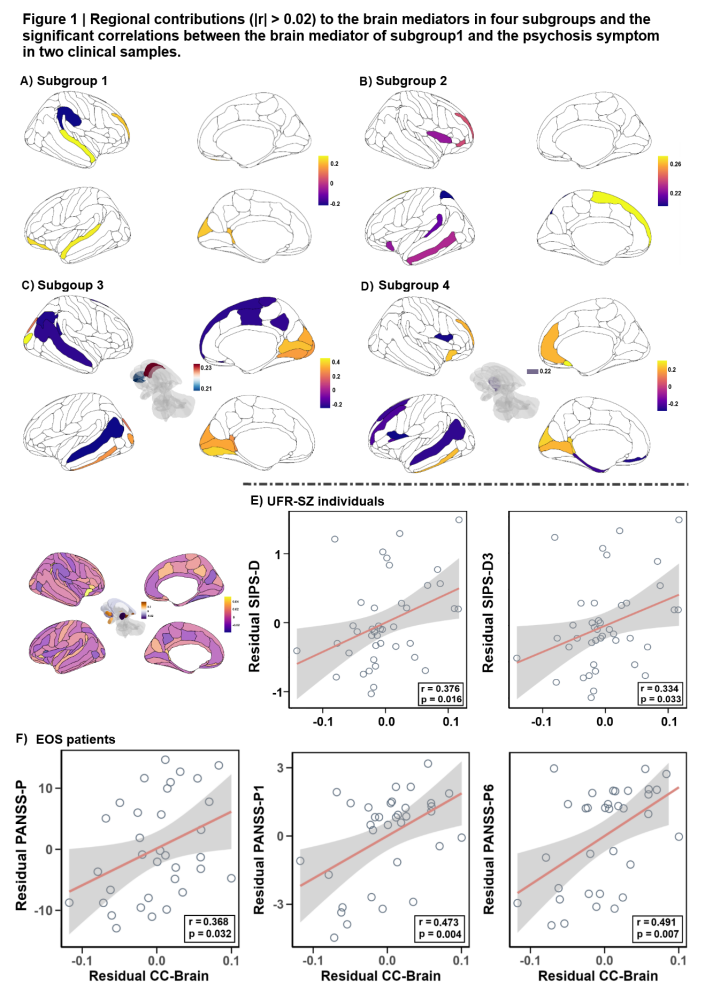
Discussion & Conclusions: These findings emphasized the importance of stratification in parsing the heterogeneity in stress-schizophrenia neural mediating pathways, highlighting a tri-network pathway.
In sessions