
Baseline-dependent normalization of salience–control connectivity after right DLPFC rTMS in alcohol use disorder: pilot support for mechanistically motivated enrichment
T.-G. Chang1,2, C.-H. Chen3, Biomedical Research Imaging Center (BRIC) at UNC Chapel Hill (for fMRI Data Processing and Analysis)
1Taichung Veterans General Hospital, Taiwan, Division of Addiction Medicine, Department of Psychiatry, Taichung, Taiwan, 2National Chung Hsing University, Taiwan, School of Post-Baccalaureate Medicine, Taichung, Taiwan, 3Taichung Veterans General Hospital, Taiwan, Department of Medical Imaging, Taichung, Taiwan
Background: Treatment response to repetitive transcranial magnetic stimulation (rTMS) in alcohol use disorder (AUD) is heterogeneous, and group-level neuroimaging effects are often inconsistent. We hypothesized that apparent inconsistency reflects baseline-dependent salience/attention-control circuit dynamics.
Aims & Objectives: To test whether changes in ventral attention network (VAN) - frontoparietal network (FPN) functional connectivity (FC) after right dorsolateral prefrontal cortex (DLPFC) rTMS depend on baseline coupling, and to evaluate a mechanistic enrichment signal for future sham-controlled trials.
Method: In an open-label pilot, six adults with AUD (mean age 46.2 +/- 11.5 years) completed resting-state functional MRI and clinical assessments at Baseline, Post-treatment, and 1-month follow-up (1M). High-frequency rTMS targeted the right DLPFC (F4, international 10-20 system): 10 Hz, 110% resting motor threshold, and 3,000 pulses/session (30,000 total; 10 sessions). VAN-FPN FC was computed using Fisher z-transformed correlations. Clinical outcomes included the Alcohol Use Disorders Identification Test (AUDIT) and craving assessed using a visual analog scale (VAS).
Results: AUDIT decreased from 31.3 +/- 7.2 at Baseline to 28.0 +/- 9.4 at 1M (Wilcoxon p = 0.042). Group-mean VAN-FPN FC change was not significant; however, individual responses were strongly baseline-dependent. Baseline VAN-FPN FC correlated negatively with change in FC (Post - Baseline) (Spearman rho = -0.94, p = 0.005; n = 6). Participants with baseline hypersynchrony (VAN-FPN > 0; n = 4) showed the largest decoupling, with directionally consistent effects at 1M (rho = -0.83, p = 0.042). Craving VAS showed high inter-individual variability across timepoints and did not consistently track with FC change.
Discussion & Conclusions: 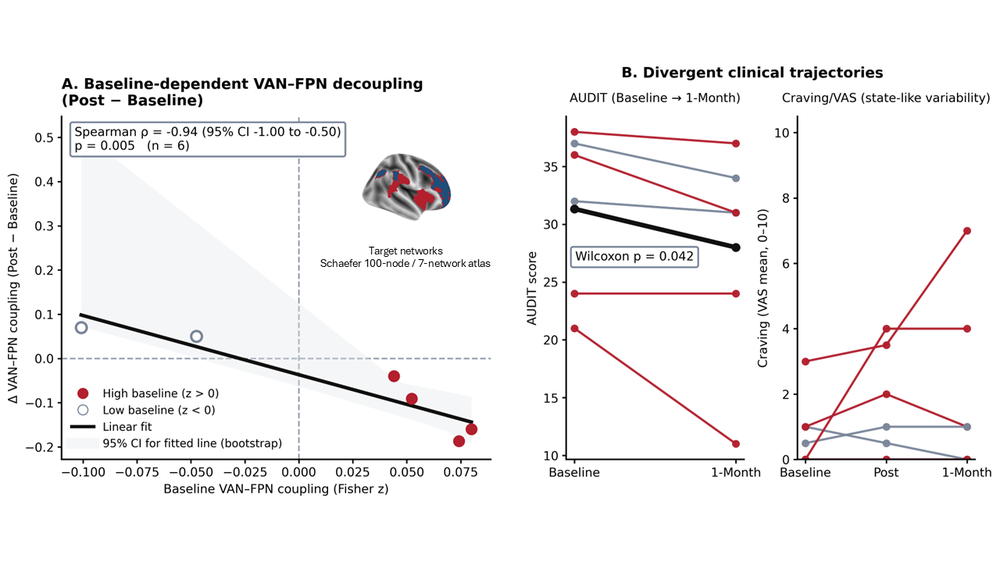
Right DLPFC rTMS was associated with reduced hazardous drinking risk and a baseline-dependent normalization pattern in salience/attention-control coupling, preferentially down-regulating VAN-FPN hypersynchrony. The dissociation between circuit decoupling and variable craving supports FC as a mechanistic biomarker. Findings are hypothesis-generating but motivate mechanistically motivated enrichment by stratifying participants on baseline VAN-FPN coupling in future sham-controlled trials.
Right DLPFC rTMS was associated with reduced hazardous drinking risk and a baseline-dependent normalization pattern in salience/attention-control coupling, preferentially down-regulating VAN-FPN hypersynchrony. The dissociation between circuit decoupling and variable craving supports FC as a mechanistic biomarker. Findings are hypothesis-generating but motivate mechanistically motivated enrichment by stratifying participants on baseline VAN-FPN coupling in future sham-controlled trials.
In sessions