
Autism spectrum disorder (ASD): zinc suppresses cerebellar ultrastructural alterations and the oxidative stress/gliosis/neuronal loss axis-mediated ASD
F. AL-Hashem1,1, H. Zafrah1,1, A. Garni2,2, A. Shati3,3, F. Almasabi1,1, B. Al-Ani1,4
1King Khalid University, College of Medicine, Physiology Depaerment, Abha, Saudi Arabia, 2King Khalid University, College of Medicine, Medicine Department, Abha, Saudi Arabia, 3King Khalid University, College of Medicine, Child Health Department, Abha, Saudi Arabia, 4King Khalid University, College of Medicine, Physiology Depaerment, Abhasau, Saudi Arabia
Background: Autism spectrum disorder (ASD) is a major mental health concern in young children, and there is a link between ASD and zinc deficiency.
Aims & Objectives: Neither the potential protective effects of the trace element zinc on the cerebellum against ultrastructural damage in animal models of ASD, nor its ability to protect against the modulation of the oxidative stress/gliosis/neuronal loss axis implicated in autism, has been previously investigated.
Method: Therefore, young rats were injected with the short-chain fatty acid produced by gut bacteria that is known to induce ASD, propionic acid (PPA) (250 mg/kg) for 5 days (model group) and the protection group was treated with 2 mg/kg zinc sulfate (PPA+ZnSO4) for two weeks post PPA injections.
Results: Cerebellum damage and behavioral impairment developed in the model group of rats as demonstrated by profound cerebellar ultrastructural alterations such as degeneration of Purkinje neurons and separation between cerebellar granule cells, as well as social anxiety and social skill deficits. PPA also significantly (p<0.001) modulated the cerebellum protein levels of the gliosis biomarker GFAP, neuronal loss biomarker calbindin D28K, and the cerebellar tissue levels of zinc, glutathione, and oxidative stress biomarker malondialdehyde (MDA). All these parameters were significantly (p≤0.001) protected by zinc sulfate. Additionally, we observed a significant (p<0.001) correlation between the score of the damaged Purkinje cells and these parameters associated with autism.
Discussion & Conclusions: PPA-induced autistic behaviours in rats are associated with alteration to the cerebellar ultrastructure, modulation of the oxidative stress/gliosis/neuronal loss axis of ASD, and a decline in zinc and glutathione, which were protected by zinc sulfate treatment. These studies are the first to demonstrate the protective effect of zinc sulfate against the induction of cerebellar ultrastructural alterations and the dysregulation of the oxidative stress/gliosis/neuronal loss axis in animal models of ASD. Additionally, we established a link between the alteration to the Purkinje cell ultrastructure and the dysregulation of the cerebellar oxidative stress, antioxidant, zinc, serotonin, gliosis, neuronal loss, and anxiety-like behavior, which further confirm the beneficial effects of zinc sulfate in ASD.
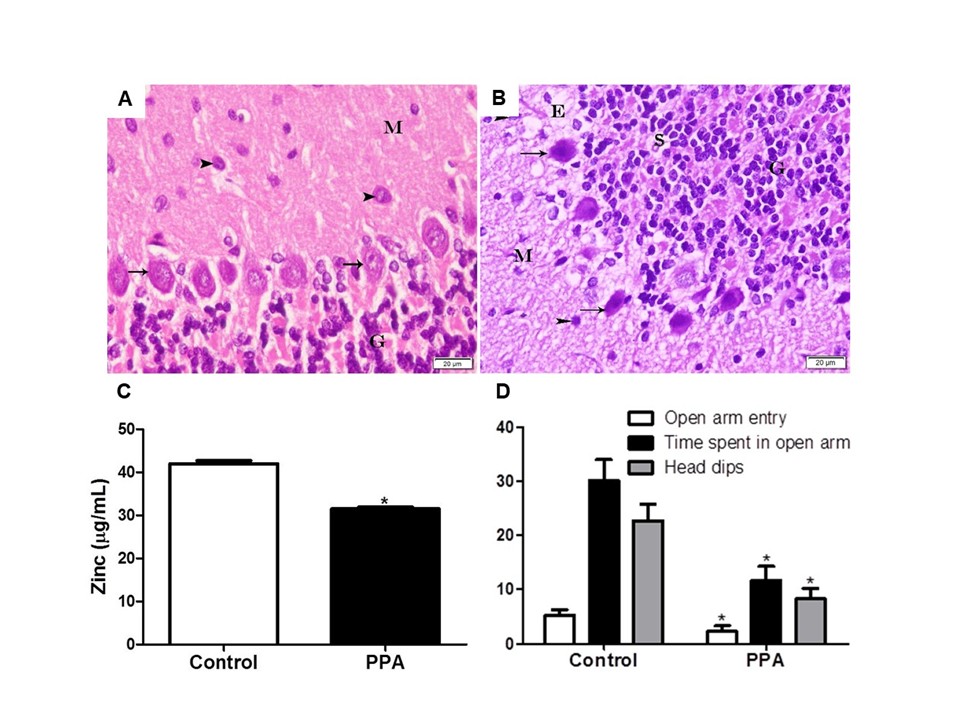 Figure 1. PPA Induces Autism Spectrum Disorder (ASD). Cerebellar cortex H&E stained images (400x) obtained from the control (A) and PPA (model) (B) groups at the end of the investigation are shown. Note that arrowheads point to the basket cells in the cerebellar molecular layer and arrows in (A) and (B) point to the normal and damaged Purkinje cells, respectively. Abbreviations: M: outer molecular; G: inner granular layer; E: empty spaces in the molecular layer; S: separation between granule cells in the granular layer. PPA intoxication also caused a significant (p<0.001) decrease in cerebellar tissue levels of zinc (C), as well as the induction of anxiety-like behavior (number of open arm entries, the time spent in the open arm, and the number of head dips) by PPA (D).
In sessions