
The interplay of causal attribution and reinforcement learning in bipolar disorder: a neural perspective
K.-T. Chen1, L. Mason2
1University College London, Institute of Cognitive Neuroscience, London, United Kingdom, 2University College London, Division of Psychology & Language Sciences, London, United Kingdom
Background: Reinforcement learning (RL) is shaped by perceived causal attributions and is supported by differential activation of brain regions, particularly the striatum. However, how these processes interact in bipolar disorder (BD) remains unclear.
Aims & Objectives: This study examined the influence of BD on causal attribution and the neural mechanisms underlying reward-belief updating within manipulated causal structures, compared with healthy controls (HCs).
Method: Twenty-three individuals with BD (5 males, 18 females) and 18 HCs (8 males, 10 females) completed a causal-manipulated reward-learning task during functional magnetic resonance imaging (fMRI). Behavioral performance was evaluated using generalized linear mixed-effects models and Bayesian RL models. Neural responses were analyzed via parametric modulators derived from the best-fitting Bayesian RL model.
Results: Behaviorally, causal attribution performance was comparable between BD and HC based on current evidence. Neuroimaging analyses revealed no evidence of striatal encoding of reward updating, despite the computational model effectively predicting behavioral performance. Instead, BD participants exhibited broader fronto-limbic engagement in response to agency-modulated signals, with increased activation in the medial frontal cortex, amygdala, and hippocampus. (See Table and Figure).
Note. All results have been whole-brain corrected at a voxel-wise threshold of p < 0.001 and cluster-corrected at p < 0.05, FWE. Results reported in italics (‡) survived voxel-wise FDR p < .05 but did not meet cluster-level FWE p < .05 and are reported as exploratory.
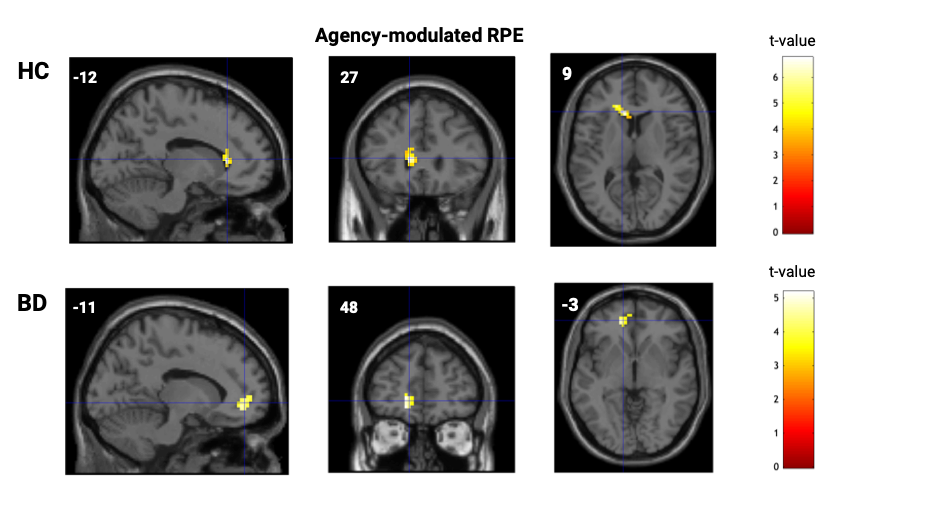
Table Significant and Exploratory Agency-Modulated RPE Clusters in HC and BD
| Region label | Extent | t Value | x | y | z |
| HC | |||||
| White matter near anterior cingulate gyrus (L) | 41 | 6.76 | -12 | 27 | 9 |
| BD | |||||
| Paracingulate gyrus (L) | 45 | 5.18 | -15 | 48 | 0 |
| Frontal medial cortex (L) | 5.09 | -15 | 45 | 6 | |
| Amygdala (L)‡ | 38 | 4.86 | -24 | -3 | -18 |
| Hippocampus, CA1 (L)‡ | 4.56 | -39 | -24 | -12 | |
| Planum temporale (L)‡ | 35 | 4.54 | -60 | -12 | 3 |
| Heschl’s gyrus (L)‡ | 4.09 | -51 | -15 | 0 | |
Note. All results have been whole-brain corrected at a voxel-wise threshold of p < 0.001 and cluster-corrected at p < 0.05, FWE. Results reported in italics (‡) survived voxel-wise FDR p < .05 but did not meet cluster-level FWE p < .05 and are reported as exploratory.
Discussion & Conclusions: These findings suggest that latent neural abnormalities may precede overt behavioral changes. Clinically, they underscore the importance of interventions that modulate underlying neural circuits and address maladaptive attributional styles through targeted interventions.
In sessions