
Effects of palmitoylethanolamide in clinical high-risk for psychosis: a nonrandomized open-label trial
R. Bortoletto1,2, M. Garzitto1, M. Basaldella1, C. Scipioni1,3, O. Sepulcri3, M. Fabris4, F. Curcio4, M. Balestrieri1, M. Colizzi1,5
1University of Udine, Department of Medicine, Unit of Psychiatry and Eating Disorders, Udine, Italy, 2Hôpital Universitaire de Bruxelles, Department of Child and Adolescent Psychiatry, Site Anderlecht, Bruxelles, Belgium, 3Friuli Centrale Health University Authority (ASUFC), Unit of Psychiatry and Eating Disorders, Udine, Italy, 4University of Udine, Department of Medicine, Institute of Clinical Pathology, Udine, Italy, 5King's College London, Department of Psychosis Studies, Institute of Psychiatry, Psychology and Neuroscience, London, United Kingdom
Background: Clinical high-risk (CHR) for psychosis state still lacks effective and safe treatments. Recent evidence supports the anti-neuroinflammatory properties of fatty acid palmitoylethanolamide (PEA) dietary supplementation across the psychosis spectrum. However, despite its safe profile, the effect of PEA supplementation in CHR remains unexplored.
Aims & Objectives: This mechanistic study aims to fill this gap through the following objectives (i) to assess trajectories of CHR symptoms and peripheral neuroimmune biomarkers during PEA supplementation; (ii) to assess associations between baseline levels of peripheral neuroimmune biomarkers and subsequent symptom trajectories during PEA supplementation; (iii) to assess associations between changes in peripheral neuroimmune biomarkers and longitudinal trajectories of CHR symptoms during PEA supplementation.
Method: Sixteen subjects at CHR for psychosis with attenuated psychotic symptoms (APS) enrolled in a 12-week, open-label, nonrandomized, single-arm clinical trial of ultramicronized-PEA (um-PEA, 600 mg/day). Biobehavioral assessments were conducted at baseline, 4 weeks, and 12 weeks, particularly using the Comprehensive Assessment of At-Risk Mental States (CAARMS) and quantifying changes in peripheral neuroimmune biomarkers. Trial registration: ClinicalTrials.gov Identifier NCT06037993.
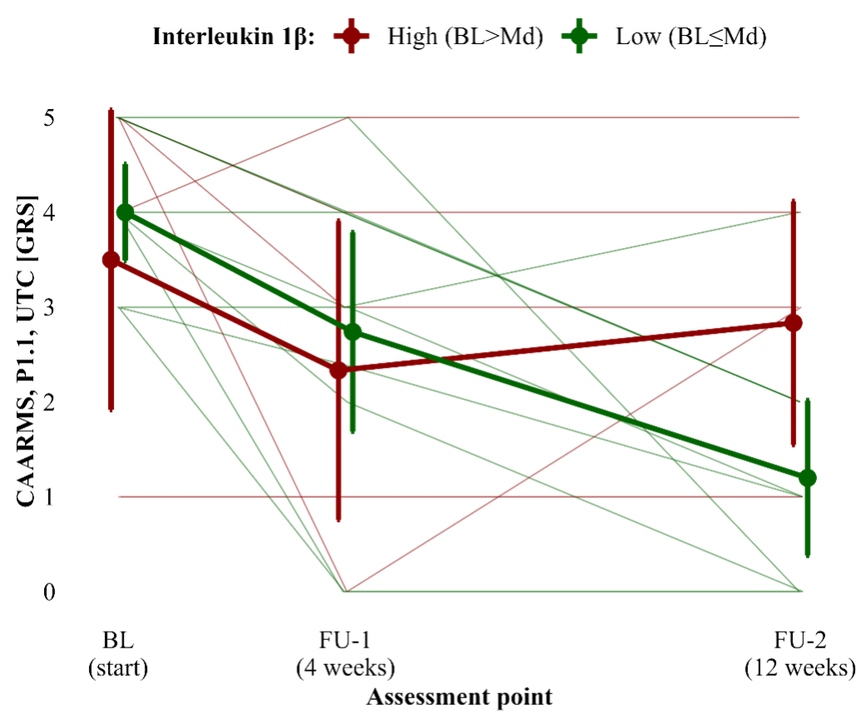
Results: Linear mixed-effects models showed significant reductions in CAARMS total APS (Δ12-weeks = −3.8 units, −30.0 %) and Unusual Thought Content (UTC; Δ12-weeks = −2.0, −52.5 %). No treatment-emergent side effects were reported. In exploratory analyses including neuroimmune biomarkers as covariates and potential moderators, lower baseline Interleukin (IL)-1β was associated with greater improvement in UTC, while time-varying IL-10/IL-6 ratio, Interferon (IFN)-γ, and IL-6 were linked to changes in CAARMS total APS and UTC.
Discussion & Conclusions: A reduction in APS was observed in subjects at CHR for psychosis receiving PEA supplementation, possibly through immune-inflammatory modulation, warranting further research into its therapeutic potential for this condition.
In sessions