
Aberrant signature methylone by DNMT1 hot spot mutation in hereditary sensory and autonomic neuropathy 1E
K. Hojo1, H. Yamanisi1, Y. Watanabe1, Y. Wu2, C. J Kiine2
1Hirakata General Hospital for Developmental Disorders, Neuropsychiatorogy, Osaka, Japan, 2Mayo Clinic, Depertment of Laboratory Medicine and Pathology, Rochester, United States
Background: DNA methylation affects many cellular functions including transcription regulation, cell differentiation, gene imprinting and genome stability. Mammalian DNA methylation is catalyzed by DNA methyltransferase (DNMT1), DNMT3A and 3B. DNMT1 locates at chromosome 19p13.3-p13.2, is the maintenance methyltransferase and essential for maintaining proper epigenetic inheritance. We identified heterozygous mutations in DNMT1targeting sequence (TS) domain causing hereditary sensory and autonomic neuropathy type 1 with dementia and sensory loss (HSAN1E). Mutation of Y495C in TS domain is most common. It decreased enzyme activity and presents clinical features of HSAN1E.
Aims & Objectives: The aim of the study was to investigate the genome-wide DNA methylation changes in HSAN1E patients arising from the hotspot mutation Y495C. There are cytosines preceding guanine nucleotides (CpGs) in the human genome and the majority of them are methylated. A small percentage of CpG dinucleotides are clustered within gene promoters as CpG islands (CGI), but normally only 3% of CpG islands are methylated.
The pathogenic role of promoter methylation has been limited understanding on how methylation changes in intergenic regions relate to human disease.
The pathogenic role of promoter methylation has been limited understanding on how methylation changes in intergenic regions relate to human disease.
Method: We analyzed CpG methylation at single-base resolution in 3 affected individuals and their age-, gender-matched (<5y in 3 y difference) unaffected siblings by whole genome bisulfite sequencing (WGBS). This paired-sample study design allowed us to perform statistical analysis of differential methylation while controlling for extraneous factors, minimizing inter-familial and environmental influences. Genomic DNA was extracted from peripheral blood B cells of three affected patients carrying the heterozygous Y495C DNMT1 mutation and Unaffected one.
Results: 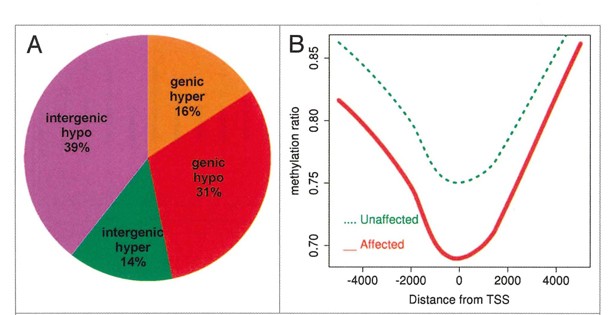
DMC (differentially methylated CpGs) distribution in different genomic regions. (A) DMCs occur across genomic regions however, intergenic regions have higher percentage of hypomethylated CpGs than genic regions. (B)Hypomethylation around transcription site (TSS). All genes are aligned around TSS and average methylationis displayed separately for affected (red) and unaffected (green) subjects.
DMC (differentially methylated CpGs) distribution in different genomic regions. (A) DMCs occur across genomic regions however, intergenic regions have higher percentage of hypomethylated CpGs than genic regions. (B)Hypomethylation around transcription site (TSS). All genes are aligned around TSS and average methylationis displayed separately for affected (red) and unaffected (green) subjects.
Discussion & Conclusions: HSAN1E is the neurodegenerative disease caused by DNMT1 mutations. The role of DNMT1 is also the only essential methyltransferase to ensure the fidelity of epigenetic inheritance. WBGS study reveals a signature pattern of methylation alteration in this affects neuronal degeneration, characterized by a prevalent hypomethylation in intergenic regions. a significant methylation decrease at surrounding TSS decreased.
In sessions