
Bridging psychiatric & somatic care: Jones Score improvements (2014-2025)
S. Riessland1,2, V. Millischer1,2, G.M. Godbersen1,2, D. Rujescu1,2, P. Baldinger-Melich1,2
1Department of Psychiatry and Psychotherapy, Clinical Division of General Psychiatry, Vienna, Austria, 2Comprehensive Center for Clinical Neurosciences and Mental Health, Vienna, Austria
Background: To address the highly prevalent gap between somatic and psychiatric needs of specific patient collectives (1), the Medical University of Vienna established a psychiatric intermediate care unit (IMCU). Its specifics have been characterized in previous publications (2, 3). A key characteristic of this psychiatric IMCU is the higher nursing care dependency, captured by the Jones Dependency Score (4). Despite its clinical relevance, systematic longitudinal data on patient characteristics and care dependency in such units remain scarce.
Aims & Objectives: This retrospective study characterizes patients admitted between January 1st, 2014 and May 3rd, 2025 and evaluates functional improvement via Jones Dependency Score from admission to discharge.
Method: We conducted a chart review of all patients treated at the psychiatric IMCU. Level of care dependency was assessed at admission and discharge using the Jones Dependency Score (five items used: eating/drinking, washing, dressing, toileting, mobility; scored 0 = independent to 4 = fully dependent). Descriptive statistics characterized the sample and paired comparisons of initial and final total Jones scores were analyzed using Wilcoxon signed-rank test, alpha = 0.05. All analyses were performed in R (v 4.2.3).
Results: Of 1.062 patients with complete records, mean age was 45.0 ± 17.8 years; 56.6% were female. The mean length of stay was 25.5 days (± 24.8; range 1–190). 53.8% were admitted involuntarily, and 17.0% received electroconvulsive therapy. The most frequent primary diagnoses were schizophrenia spectrum disorders (32.7%), affective disorders (19.6%), organic mental disorders (13.1%), anorexia nervosa (11.5%), and substance use disorders (10.5%). Jones scores improved across all domains, with mean item reductions of 1.1–1.3 points and a total score decrease from 12.9 to 6.7 points. The total score reduction was statistically significant (median = 14, 5; interquartile range (IQR) [7-19, 2-10]; V = 414,376; p < 0.001; r = 0.74), indicating lower care dependency at discharge.
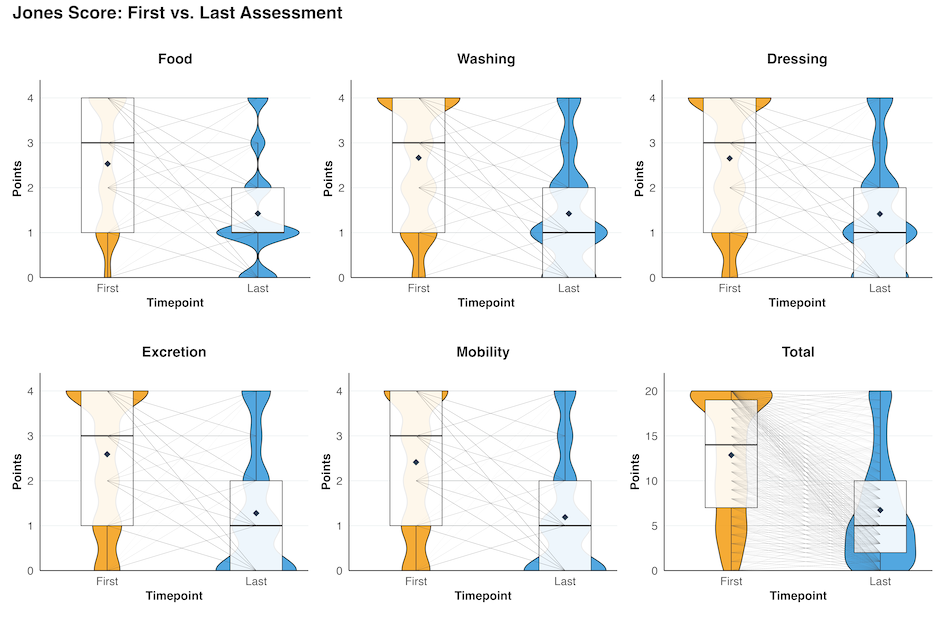 Figure: First/Last Jones scores by subgroup/total (violin+boxplot: mean=diamond, median= line, IQR=whiskers). Connecting lines show patient trajectories.
Discussion & Conclusions: Patients showed marked improvement in self-care ability, as indicated by substantial reductions in Jones Dependency scores. This underscores the role of specialized IMCU in bridging psychiatric and somatic treatment and promoting functional recovery in acutely ill psychiatric inpatients.
In sessions