
Reviewing the evidence for sertraline in the treatment paradigm for premenstrual dysphoric disorder - an opportunity
K. Subramaniam1, P. Purushottamahanti2, E. F Chettiar3
1Viatris Inc, Global Medical Affairs, Auckland, New Zealand, 2Viatris Inc, Global Medical Affairs, Bangalore, India, 3Viatris Inc, Global Medical Portfolio Services, Bangalore, India
Background: Some women experience cognitive, affective and physical symptoms in the week before menses during the luteal cycle, that can range in severity [1]. Descriptions have evolved from “premenstrual tension” to “premenstrual syndrome” to a clearly defined “pre-menstrual dysphoric disorder (PMDD)”, which is a severely disabling condition affecting 1.6% (31 million) females worldwide [2]. Consensus on diagnostic criteria has also evolved over decades, and PMDD is now included in the DSM and ICD classification systems as a distinct clinical entity [3,4]. Despite this, PMDD remains poorly recognized and underdiagnosed by clinicians [5]. Treatment options include psychological therapies; alternative and complementary medicines; and pharmacological treatments, with surgery reserved for refractory cases [6].
Aims & Objectives: Understand evidence for PMDD treatment with sertraline, the selective serotonin reuptake inhibitor (SSRI) that has been more often prescribed for affective disorders recently, in England and elsewhere [7,8,9,10].
Method: A narrative review of the scientific literature, limited to articles published in English this century, was performed on Google and, PubMed and Ovid databases with a search strategy that included PMDD; premenstrual dysphoric disorder; treatment; pharmacotherapy; SSRI; sertraline; and clinical practice guidelines as key terms.
Results: The search returned 220 articles, of which 11 were relevant. The efficacy of sertraline in PMDD had been established through studies that evaluated both continuous therapy throughout the menstrual cycle and luteal phase (~14 days) dosing only. This efficacy confers symptom-relief of depression, anger/irritability, appetite and food cravings, concentration and memory effects, and also physical symptoms. There was no evidence of sertraline withdrawal symptoms following discontinuation after 2 weeks of treatment for 2 cycles [6,11,12,13].
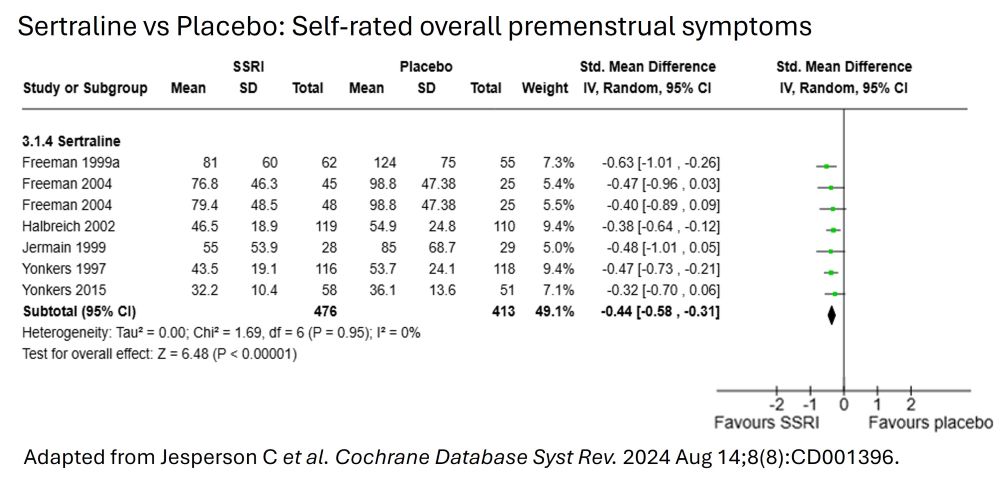
Discussion & Conclusions: Sertraline and other SSRIs are the gold standard of treatment recommended by clinical guidelines as first-line for PMDD [15]. While approved for use in the USA and some other countries, it is not yet endorsed in Europe from a time when PMDD was not a recognized diagnosis in the ICD. Schroll and Lauritsen provide an erudite discussion and opinion on finding “a proper balance between acknowledging and caring for the sick and at the same time protecting the healthy from overdiagnosis and overtreatment” [16]. Perhaps, it is time?
In sessions