
Alprazolam for symptom relief: addressing the more troublesome features of anxiety disorders
S. Shirol1, S. Awasthi2, A. Fagiolini3, K. Subramaniam4, P. Purushottamahanti1
1Viatris, Global Medical Affairs (CNS), Bengaluru, India, 2Viatris, Global Medical Services, Bengaluru, India, 3University of Siena School of Medicine, Molecular Medicine, Siena, Italy, 4Viatris, Global Medical Affairs (CNS), Auckland, New Zealand
Background: Anxiety disorders are the world’s most common mental disorders, affecting 359 million people in 20211, and a lifetime prevalence up to 33.7%2. Among those with anxiety disorders, patients having generalized anxiety disorder (GAD) demonstrate a considerable degree of impairment and disability resulting in significant economic burden, especially with an increase in health care resource utilisation(22%)3. The classic triad of sensory motor issues (muscular/ somatic tension), autonomic hyperactivity, and intellectual issues (hypervigilance/ cognitive worry) constitutes the more troublesome symptom cluster and may offer a neurobiological basis for GAD4.
Aims & Objectives: Assess the impact of alprazolam on the more troublesome features of anxiety disorders, quantified by scores on HAM-A items associated with those symptoms.
Method: Clinical studies assessing the short-term impact of alprazolam in severely anxious patients aged 18 to 70 years were identified from the clinical study reports (CSRs: 6209, 6210, 6211 and 6239). The troublesome features of tension (muscular/ somatic), autonomic hyperactivity and intellectual issues were mapped to their respective items on the HAM-A scale, and a meta-analysis was performed using RevMan software (Cochrane), with heterogeneity assessed using Chi-squared, Tau and I-squared statistic tests, as the studies had different population sizes.
Results: The overall effect of alprazolam on the more troublesome features that were mapped to the selected items of the HAM-A scale is shown below. Heterogeneity among the studies was found to be within the acceptable range. Symptom specific analyses showed alprazolam consistently reduced symptoms (Figure 1) associated with somatic (muscular) (MD = −0.33,I² = 32%), somatic (sensory) (MD = −0.28, I² = 0%), intellectual (MD = −0.39, I² = 51%), and autonomic functions (MD = −0.53, I² = 75%).
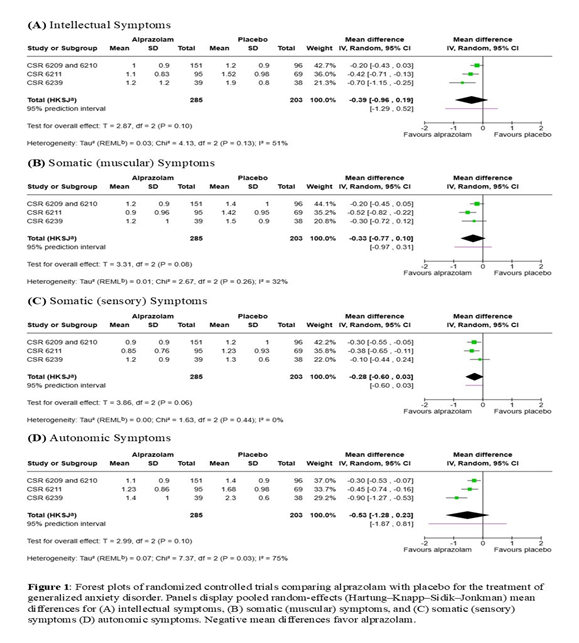
Discussion & Conclusions: This post-hoc analysis of clinical studies of alprazolam demonstrated the effect of its short-term use in alleviating autonomic hyperactivity, tension, and intellectual issues. The reduction in these symptoms is likely the result of positive allosteric modulation of GABA-A receptors by alprazolam. Any attendant risk of dependence, tolerance, or sedation may be minimized by using the lowest effective dose with planned tapering over a short treatment duration.
In sessions