
Facilitating gender equity in neuropsychopharmacological clinical research
C. U Correll1,2, A. Fagiolini3, M. Paulita Mariano4, K. Subramaniam5, P. Purushottamahanti6, B. Bayan7, J. P Cook8, E. Biesheuvel9, J. Yeow10, L. Bryden11, E. OC Palmer11, N. Lipunova11
1Zucker Hillside Hospital, Northwell Health, Department of Psychiatry, Glen Oaks, New York, United States, 2Charité Universitätsmedizin, Department of Child and Adolescent Psychiatry, Berlin, Germany, 3University of Siena School of Medicine, Department of Molecular Medicine, Siena, Italy, 4University of the East Ramon Magsaysay Memorial Medical Centre, Department of Psychiatry, Quezon City, Philippines, 5Viatris Inc, Global Medical Affairs, Auckland, New Zealand, 6Viatris Inc, Global Medical Affairs, Bangalore, India, 7Viatris Inc, Real World Data and Analytics, Bangalore, India, 8Viatris Inc, Real World Data and Analytics, Morgantown, WV, United States, 9Viatris Inc, Biometrics, Amstelveen, Netherlands, 10Holmusk Technologies Inc., Real World Evidence, Singapore, Singapore, 11Holmusk Technologies Inc., Real World Evidence, London, United Kingdom
Background: Depressive and anxiety disorders are significantly more common in women than in men [1]. Despite higher prevalence, there is paucity of published evidence on the evaluation of efficacy and safety of drugs used for these conditions in women [2]. Various guidelines recommend inclusion of women and minorities in clinical research to address this equity gap [3,4]. Nevertheless, women continue to be underrepresented in clinical trials.
Aims & Objectives: To perform post hoc analyses specific to women, and design studies that are powered to analyze the influence of sex on the results in patients with major depressive disorder (MDD) or generalized anxiety disorder (GAD) prescribed sertraline or venlafaxine, respectively.
Method: A post hoc pooled analysis of nine clinical trials of sertraline was performed to evaluate its efficacy (measured through change in 17-item Hamilton Depression Rating Scale (HAM-D17) and Clinical Global Impressions-Severity (CGI-Severity) scores) and safety in women with MDD. Influence of sex was also evaluated in two retrospective real-world studies that explored the effectiveness (all-cause discontinuation at 2 and 3 months) of sertraline in MDD, and the effectiveness (change from baseline in Generalized Anxiety Disorder 7-item (GAD-7) score) of venlafaxine in GAD.
Results: The pooled analyses showed that the changes from baseline in total HAM-D17 and CGI-Severity scores were significantly higher for sertraline than for placebo at the end of 8 weeks. (Fig 1A and 1B) [5].
The real-world studies demonstrated that there were no statistically significant differences between men and women across all outcomes measured for both sertraline and venlafaxine (Fig 1C and 1D) [6,7].
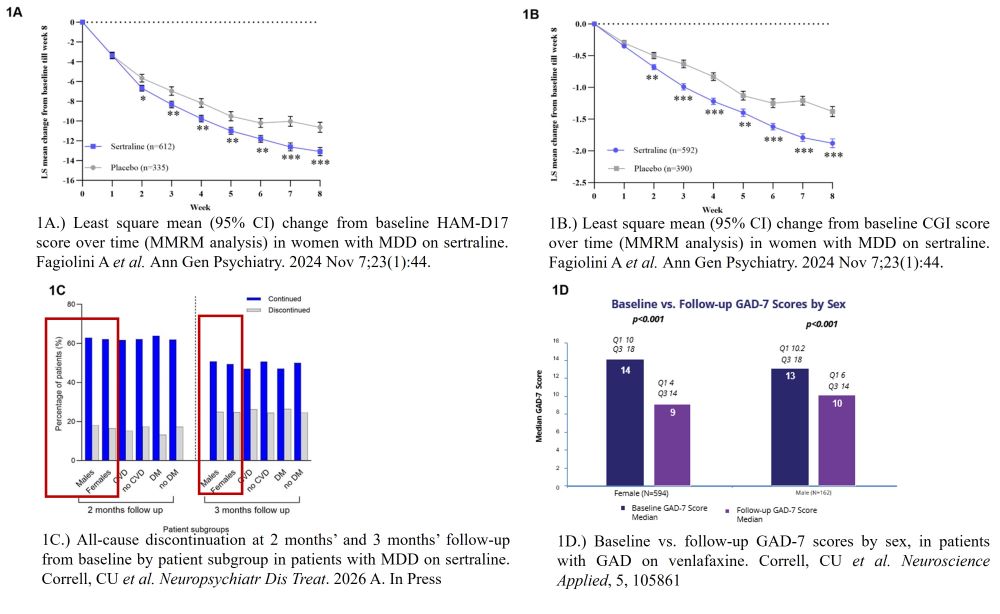
The real-world studies demonstrated that there were no statistically significant differences between men and women across all outcomes measured for both sertraline and venlafaxine (Fig 1C and 1D) [6,7].
Discussion & Conclusions: These studies provide evidence of effectiveness of sertraline and venlafaxine in women, enabling clinicians to make an evidence-based, personalized choice when selecting an appropriate medication for their female patients. Although no sex differences were observed, this should not be equated with biological equivalence. Further studies should likewise examine sex- and gender-specific factors, such as pharmacokinetics, hormonal influences, medication and diagnostic interactions, and phenotypical gender differences to guide treatment choices (e.g., sequential menstrual cycle/phase-based dosing in women and medication combinations), ultimately maximizing the likelihood of rapid remission and optimal tolerability in a personalized manner.
In sessions