
The Mechanism of Ketamine’s Anti-Suicidal Action: From Glutamatergic Surge to Neuroplasticity via the Opioid-Attachment Interface
A. Solomon1, Y. Domany1,2
1Tel Aviv University, Gray Faculty of medical & health sciences, Tel Aviv, Israel, 2mayanei Hayeshua, psyciatry, Beni Brak, Israel
Background: A critical gap exists in understanding the biological mechanism linking ketamine’s rapid anti-suicidal effects to the Interpersonal Theory of Suicide (IPTS). While the "Kinetic Mismatch" between acute relief and delayed synaptogenesis is well-known, current models overlook how ketamine modulates "Thwarted Belongingness" (a core IPTS pillar) and the attachment anxiety that drives suicidal risk in the acute phase.
Aims & Objectives: To propose an integrated mechanistic model of ketamine’s anti-suicidal action. We aim to demonstrate that the resolution of suicidality is not merely a result of downstream plasticity, but relies on an acute Glutamatergic-Opioid interaction that regulates the anxiety of ego-dissolution and social abandonment, particularly in phenotypes of Insecure Attachment.
Method: We present a theoretical synthesis based on our clinical trials, observations, and current neurobiological literature. We map the phenomenology of the "ketamine experience" onto a sequential biological cascade involving Default Mode Network (DMN) modulation, opioid system activation, bioenergetic restoration, dendritic sprouting, and neuroplasticity.
Results:
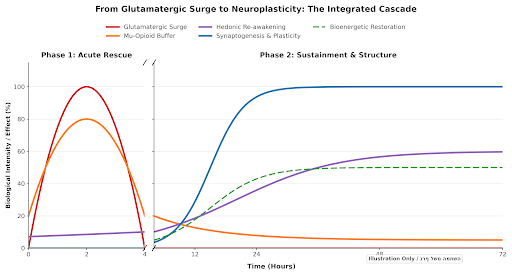 The proposed model outlines a precise chronological trajectory of recovery:
Phase 1: The Surge & Buffer (Acute Rescue). Ketamine triggers a Glutamatergic Surge that inhibits the DMN, dismantling rigid priors. Crucially, we posit that the Mu-opioid system is simultaneously recruited to buffer the anxiety of disintegration. This targets "Thwarted Belongingness" and social pain—a mechanism vital for patients with Insecure Attachment.
Phase 2: Sustainment (Hedonia & Plasticity). Parallel to acute relief, Hedonic Re-awakening bridges the gap to structural change. The cascade culminates in Neuroplasticity: bioenergetic recovery fuels dendritic sprouting and synaptic strengthening. This final structural restoration solidifies resilience against depressive symptoms
Discussion & Conclusions: We conclude that ketamine’s anti-suicidal efficacy is a Bio-Social process. The drug’s ability to reggulate the DMN while buffering the resulting anxiety via the opioid system allows vulnerable patients to safely navigate the transition from rigid psychopathology to neuroplasticity. This model supports a phenotype-stratified approach, identifying attachment style as a key predictor of the rapid anti-suicidal response.
In sessions