
Educational attainment–related genetic and structural divergences between schizophrenia and bipolar disorder
W. Du1, G. Lei1, Z. Gao1, S. Lui1
1West China Hospital of Sichuan University, Department of Radiology, Chengdu, China
Background: Schizophrenia (SCZ) and bipolar disorder (BD) share substantial genetic overlap and both involve cognitive impairments. Educational attainment (EDU), a key proxy for cognition, differs significantly between the two disorders. However, how the genetic architecture linking EDU to SCZ and BD diverges remains unclear.
Aims & Objectives: The aim of this study is to systematically investigate and compare the genetic architecture linking educational attainment (EDU) with schizophrenia (SCZ) and bipolar disorder (BD), and to elucidate the neurobiological mechanisms underlying their shared and distinct cognitive and psychiatric risk pathways.
Method: We utilized large-scale genome-wide association study (GWAS) summary statistics to characterize global, local, and functional genetic correlations among EDU, SCZ, and BD. Cross-trait meta-analyses, colocalization, and bidirectional Mendelian randomization (MR) were used to identify shared loci and causal relationships. Tissue- and cell-type enrichment and summary-data-based MR analyses highlighted functional convergence in brain regions. Guided by these findings, neuroimaging analysis including 50 SCZ patients, 35 BD patients, and 60 healthy controls was performed whether EDU–disorder associations were mediated by gray matter volume (GMV).
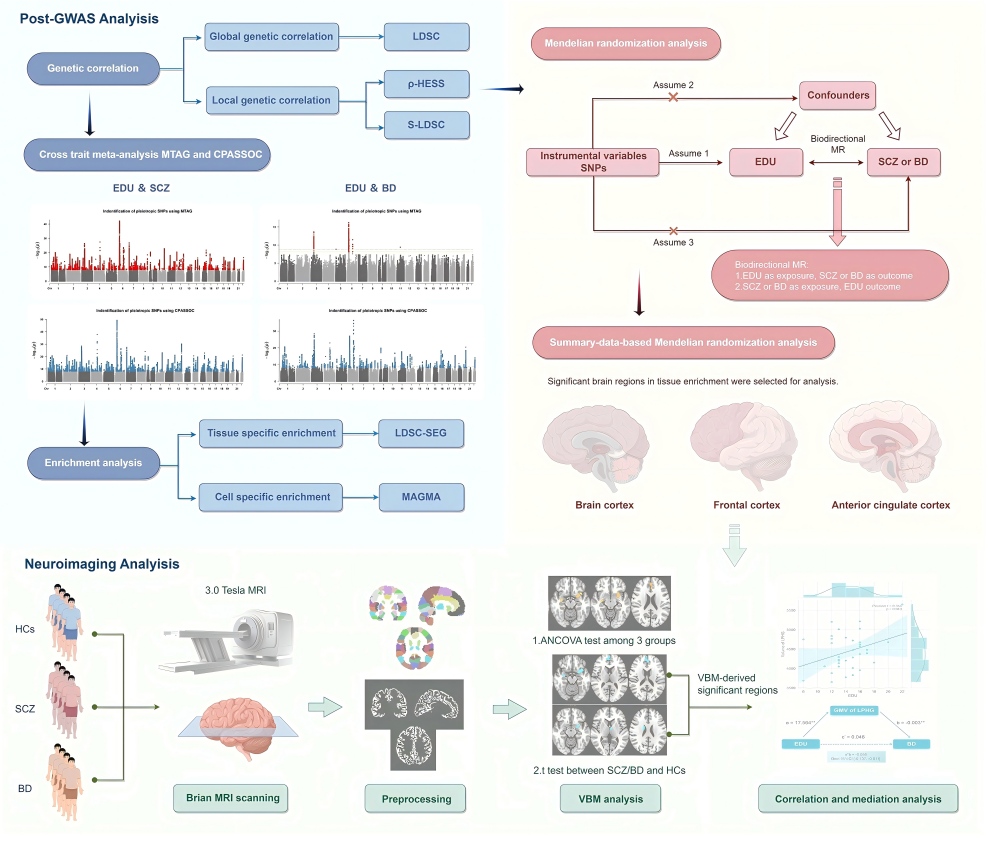 Figure 1. Workflow of genome-wide cross-trait analyses for educational attainment, schizophrenia, and bipolar disorder. The overall study workflow for investigating shared genetic architecture is shown.
Results: EDU showed a stronger genetic correlation with SCZ than BD. Cross-trait meta-analysis identified 32 shared SNPs for EDU-SCZ and 8 for EDU-BD. Bidirectional MR indicated a causal association between EDU and SCZ. EDU, SCZ, and BD shared heritability enrichment in the brain cortex, prefrontal cortex, and anterior cingulate cortex, with distinct cell-type enrichments. WBP2NL and NAGA were identified as functional genes shared by EDU and SCZ across multiple brain regions. Neuroimaging analysis indicated that EDU positively associated with the GMV in the left parahippocampal gyrus which also mediated the EDU-BD relationship.
Discussion & Conclusions: EDU shows broader and more convergent genetic associations with SCZ, whereas in BD, its influence may operate through specific neurostructural pathways, highlighting distinct mechanisms linking cognitive potential to psychiatric vulnerability.
In sessions