
Effects of palmitoylethanolamide on psychic distress and daily functioning in autistic adults: a nonrandomized open-label trial
R. Bortoletto1,2, M. Garzitto1, M. Basaldella1, C. Scipioni1,3, O. Sepulcri3, M. Fabris4, F. Curcio4, M. Colizzi1,5
1University of Udine, Department of Medicine, Unit of Psychiatry and Eating Disorders, Udine, Italy, 2Hôpital Universitaire de Bruxelles, Department of Child and Adolescent Psychiatry, Site Anderlecht, Bruxelles, Belgium, 3Friuli Centrale Health University Authority (ASUFC), Unit of Psychiatry and Eating Disorders, Udine, Italy, 4University of Udine, Department of Medicine, Institute of Clinical Pathology, Udine, Italy, 5King's College London, Department of Psychosis Studies, Institute of Psychiatry, Psychology and Neuroscience, London, United Kingdom
Background: Autistic adults lack treatments for co-occurring psychic distress and mental health challenges. The inflammomodulatory properties of the endocannabinoid (eCB)-like compound palmitoylethanolamide (PEA) may represent a strategy to address this unmet clinical need.
Aims & Objectives: We proposed a mechanistic study to assess the effect of PEA on psychic distress in autistic adults with low level of support needs, focusing on clinical outcomes and inflammatory biomarkers.
We explored whether (i) symptoms of psychic distress improve during PEA administration, (ii) autistic traits (ATs) moderate symptom trajectories during PEA administration, and (iii) peripheral inflammatory biomarkers’ levels moderate symptom trajectories during PEA administration.
We explored whether (i) symptoms of psychic distress improve during PEA administration, (ii) autistic traits (ATs) moderate symptom trajectories during PEA administration, and (iii) peripheral inflammatory biomarkers’ levels moderate symptom trajectories during PEA administration.
Method: Fifteen level 1 autistic adults enrolled in a 12-week, open-label, nonrandomized, single-arm proof-of concept study of ultramicronized-PEA (um-PEA, 600 mg/day). Biobehavioral assessments were conducted at baseline, 4 weeks, and 12 weeks, using the Symptom Checklist-90-Revised (SCL-90-R), Hospital Anxiety and Depression Scale (HADS), and World Health Organization Disability Assessment Schedule 2.0 (WHODAS), alongside quantification of peripheral inflammatory biomarkers. Trial Registration: ClinicalTrials.gov Identifier NCT06187090.
Results: 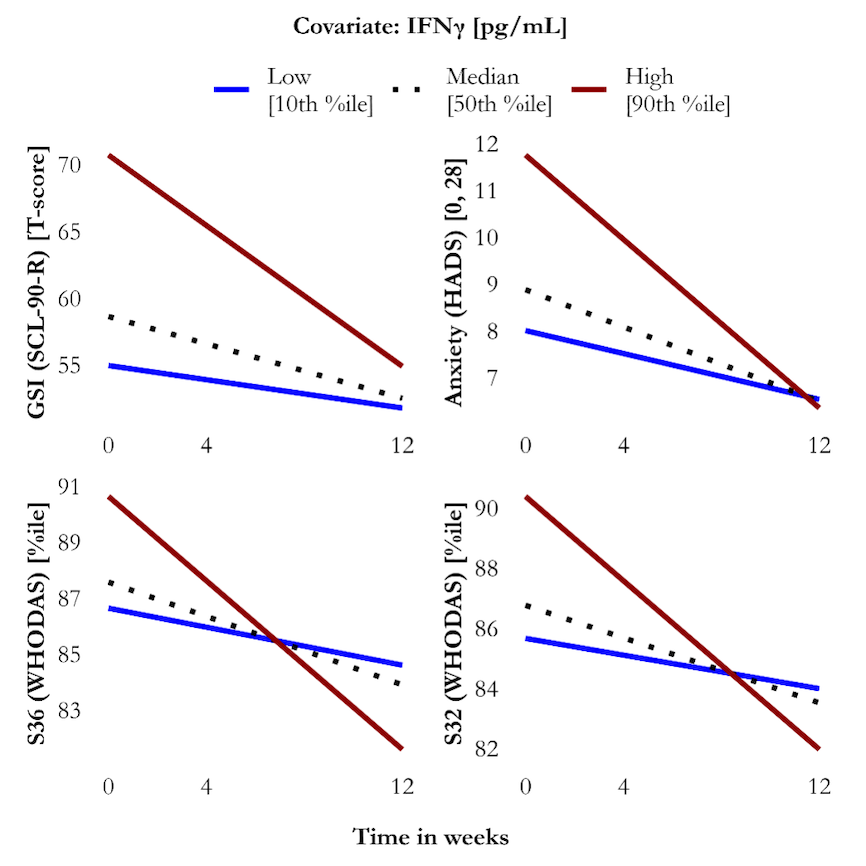
Linear mixed-effects models showed significant reductions in the SCL-90-R Global Severity Index (Δ12-weeks: -8.5 ±10.33 T-scores), self-reported anxiety (-3.1 ±2.79 total score points), and functional impairment (-4.7 ±5.57 percentiles, with work/study commitments; -4.3 ±4.96, without). No side effects emerged. Exploratory analyses indicated greater improvements among participants with a biological profile skewed toward acute pro-inflammatory activity, including higher baseline Interferon (IFN)-γ, Interleukin (IL)-8, and IL-17A, but lower IL-10 and erythrocyte sedimentation rate (ESR). Lower autistic traits (ATs) were associated with transient increase in basophils.
Linear mixed-effects models showed significant reductions in the SCL-90-R Global Severity Index (Δ12-weeks: -8.5 ±10.33 T-scores), self-reported anxiety (-3.1 ±2.79 total score points), and functional impairment (-4.7 ±5.57 percentiles, with work/study commitments; -4.3 ±4.96, without). No side effects emerged. Exploratory analyses indicated greater improvements among participants with a biological profile skewed toward acute pro-inflammatory activity, including higher baseline Interferon (IFN)-γ, Interleukin (IL)-8, and IL-17A, but lower IL-10 and erythrocyte sedimentation rate (ESR). Lower autistic traits (ATs) were associated with transient increase in basophils.
Discussion & Conclusions: This proof-of-concept study provides the first evidence on the biobehavioral potential of PEA supplementation in autistic adults experiencing psychic distress. PEA was safe and well tolerated, and was associated with improvements in general psychological wellbeing, anxiety, and adaptive functioning. Baseline inflammatory profiles may influence treatment responsiveness, supporting the role of PEA as a homeostatic modulator of inflammation. Despite preliminary, these findings highlight PEA as a promising therapeutic option for non-core mental health symptoms in autistic adults, warranting confirmation through larger randomized controlled trials.
In sessions